 Add to Chrome
 Add to Firefox
 Add to Edge
Orthogonal Negative Guidance in Attention Feature Space for Text-to-Image Generation
May 28, 2026
Text-to-image (T2I) models have become increasingly capable of generating high-quality images. Yet, enforcing the explicit absence of a specified object or attribute remains a fundamentally challenging problem. Existing approaches, including prompt negation, post-hoc editing, and negative guidance, remain insufficient for explicit concept suppression, often failing to remove the target concept or degrading overall image quality. To this end, we propose Orthogonal Negative Guidance in attention feature space, a training-free method that operates in the attention output space of MM-DiT-based T2I transformers. Our method orthogonalizes negative-prompt attention features with respect to positive-prompt features and subtracts only the orthogonal component, suppressing unwanted concepts while preserving desired semantics. Experiments on FLUX-dev and FLUX-schnell show that our method achieves favorable trade-offs between concept suppression, prompt alignment, and image quality. In human evaluation, our method outperforms the second-best baseline by 18.78%. We further show that our method supports multi-concept suppression and adjustable concept suppression.

When Confidence Misleads: Suffix Anchoring and Anchor-Proximity Confidence Modulation for Diffusion Language Models
May 27, 2026Diffusion language models decode text by iteratively denoising masked token sequences, making the choice of which positions to decode a central inference-time decision. Most training-free decoding strategies use model confidence for position selection, assuming that high-confidence positions are ready to be decoded. In this work, we revisit this assumption by studying when confidence misleads fully non-autoregressive (fully non-AR) decoding. EOT tokens can receive high confidence and cause incomplete generation; inserting a suffix anchor can mitigate this issue but introduces local overconfidence near the anchor, causing anchor-adjacent tokens to be decoded too early. To address these issues, we propose Suffix-Anchored Confidence Modulation, a simple training-free method that inserts a short suffix anchor to encourage response completion and modulates confidence near the anchor according to decoding progress. This preserves the response-completion benefit of suffix anchoring while reducing premature decoding of anchor-adjacent tokens. Across text-only reasoning, vision-language reasoning, and code-generation benchmarks, our method consistently improves confidence-based fully non-AR decoding, outperforms explicit EOT suppression, and preserves the parallel decoding advantage of fully non-AR generation.
Selective Aggregation of Attention Maps Improves Diffusion-Based Visual Interpretation
Apr 07, 2026Numerous studies on text-to-image (T2I) generative models have utilized cross-attention maps to boost application performance and interpret model behavior. However, the distinct characteristics of attention maps from different attention heads remain relatively underexplored. In this study, we show that selectively aggregating cross-attention maps from heads most relevant to a target concept can improve visual interpretability. Compared to the diffusion-based segmentation method DAAM, our approach achieves higher mean IoU scores. We also find that the most relevant heads capture concept-specific features more accurately than the least relevant ones, and that selective aggregation helps diagnose prompt misinterpretations. These findings suggest that attention head selection offers a promising direction for improving the interpretability and controllability of T2I generation.
Cross-Attention Head Position Patterns Can Align with Human Visual Concepts in Text-to-Image Generative Models
Dec 03, 2024


Recent text-to-image diffusion models leverage cross-attention layers, which have been effectively utilized to enhance a range of visual generative tasks. However, our understanding of cross-attention layers remains somewhat limited. In this study, we present a method for constructing Head Relevance Vectors (HRVs) that align with useful visual concepts. An HRV for a given visual concept is a vector with a length equal to the total number of cross-attention heads, where each element represents the importance of the corresponding head for the given visual concept. We develop and employ an ordered weakening analysis to demonstrate the effectiveness of HRVs as interpretable features. To demonstrate the utility of HRVs, we propose concept strengthening and concept adjusting methods and apply them to enhance three visual generative tasks. We show that misinterpretations of polysemous words in image generation can be corrected in most cases, five challenging attributes in image editing can be successfully modified, and catastrophic neglect in multi-concept generation can be mitigated. Overall, our work provides an advancement in understanding cross-attention layers and introduces new approaches for fine-controlling these layers at the head level.
Unveiling Key Aspects of Fine-Tuning in Sentence Embeddings: A Representation Rank Analysis
May 18, 2024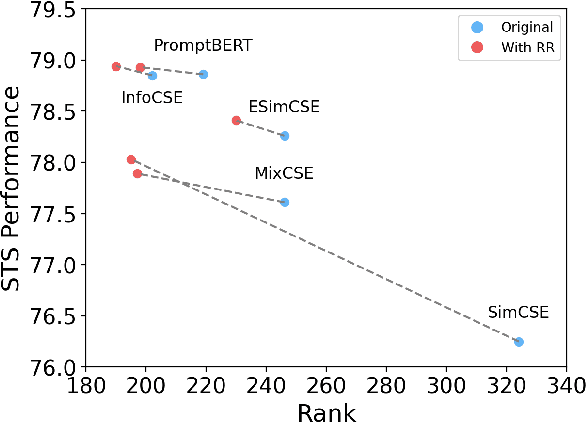
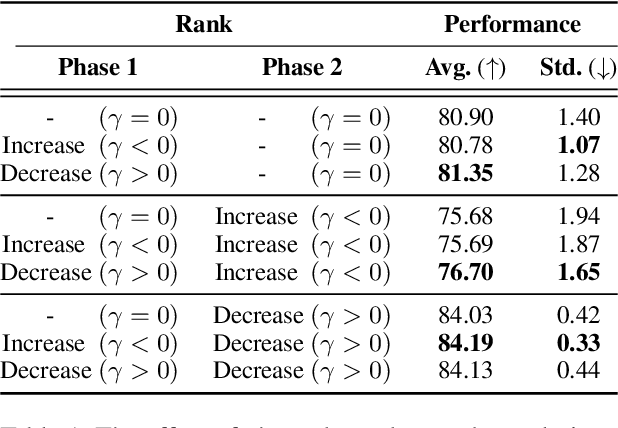
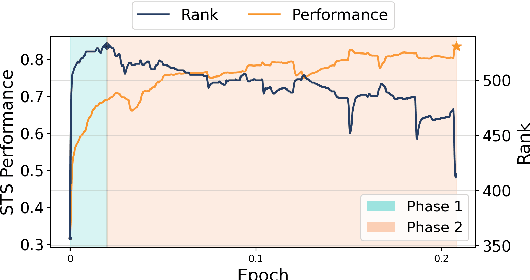
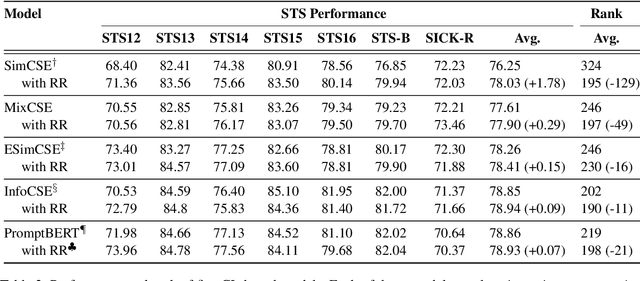
The latest advancements in unsupervised learning of sentence embeddings predominantly involve employing contrastive learning-based (CL-based) fine-tuning over pre-trained language models. In this study, we analyze the latest sentence embedding methods by adopting representation rank as the primary tool of analysis. We first define Phase 1 and Phase 2 of fine-tuning based on when representation rank peaks. Utilizing these phases, we conduct a thorough analysis and obtain essential findings across key aspects, including alignment and uniformity, linguistic abilities, and correlation between performance and rank. For instance, we find that the dynamics of the key aspects can undergo significant changes as fine-tuning transitions from Phase 1 to Phase 2. Based on these findings, we experiment with a rank reduction (RR) strategy that facilitates rapid and stable fine-tuning of the latest CL-based methods. Through empirical investigations, we showcase the efficacy of RR in enhancing the performance and stability of five state-of-the-art sentence embedding methods.